In data science, simply possessing technical skills is no longer a predictor of success. What differentiates successful data science teams, and individual data scientists, is their preferred mode of interaction with others in their organization. This insight forms the basis of the ABC Framework, which identifies three core personas: Analyst, Builder, and Consultant.
The ABC Framework extends the earlier concept of Analyst/Builder data scientist and emphasizes that an individual’s ingrained interaction style is more significant than their learned skills for managing team dynamics and achieving success. Data science teams often tackle a diverse range of projects, from quick analyses and medium-term research to long-term strategic initiatives. To excel, teams require a combination of the three personas, ensuring all necessary approaches are covered.
Let’s dive into the characteristics of each persona:
1. The Analyst
The Analyst’s primary focus is on solving a problem. They are driven by intellectual curiosity and the satisfaction of uncovering insights, solving complex puzzles, and the “aha!” moment of discovery. This persona is most visible in individuals with a background in mathematics and statistics.
Analysts excel at focused work, exploring various avenues, and applying a broad toolbox of techniques and algorithms. They understand theory and are good at breaking down complex work into chunks or steps.
They are typically less adept at building things that will last, setting up technical infrastructure, or dealing with complex platforms. Context switching and working on multiple things at once can be a source of significant stress.
Analyst’s communication tends to be in the form of detailed reports, statistical summaries, and in-depth explanations of methodologies and findings.
A typical career path leads them into specialized research roles, leading analytical teams, or becoming subject matter experts in domains requiring deep analytical rigor.
2. The Builder
For the Builder, the key focus lies in tools and infrastructure. They are driven by the challenge of designing and implementing efficient systems, seeing their code deployed and functioning reliably. Individuals with a computer science background often have this as their dominant persona.
Builders are skilled at creating code libraries, and setting up infrastructure, databases, servers – things that will last. In teams, individuals with a strong Builder persona are critical for turning models into products.
They often struggle with analyzing open-ended problems, writing a robust analysis narrative, and handling uncertainty in project plans.
Builders communicate through technical documentation, code reviews, and discussions focused on system architecture and implementation details. They prefer to show how things work.
Their career advancement leads to roles like data engineers, MLOps engineers, software architects, or heads of development teams responsible for data products and platforms.
3. The Consultant
The Consultant’s main priority is effective communication with the customer. They are motivated by driving business impact and seeing their recommendations lead to concrete actions. They thrive on collaborative problem-solving. It is difficult to identify a typical background for a Consultant persona, but roles with emphasis on communication skills are a good indicator.
Consultants are excellent at turning analysis outcomes into narratives and action plans. They possess strong data visualization and presentation skills, understand the background of clients’ requests, and are good at making connections. Juggling multiple engagements and responsibilities, putting together quick dashboards or reports to illustrate results are also their strong points.
They may struggle with deep work on a single project, and designing or implementing complex technical solutions.
Consultants excel at simplifying complex information, translating technical jargon into business language, and engaging stakeholders through compelling presentations and clear, concise summaries.
They typically progress into roles like product managers, analytics managers, business intelligence leads, or strategic consultants, bridging the gap between technical teams and business stakeholders.
Visualizing the Framework: The ABC Triangle
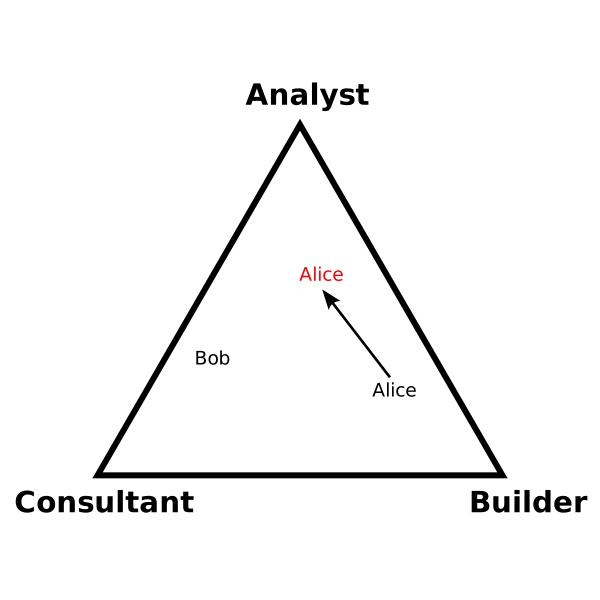
The ABC Triangle
Imagine these three personas as the vertices of a triangle. By analyzing behavior and performance in various interactions, we can place team members inside this triangle to reflect their dominant and minor personas. One must resist locating anyone in the center of the triangle or at any one of the vertices. To identify the dominant persona look for modes of interaction that feel natural or are assumed by default in projects.
One can also visualize each person’s journey through the ABC Triangle: where are they now, where would they want to be, and where do they feel comfortable?
Practical Applications for Hiring and Team Design
The ABC Framework can help with building and managing high-performing data science teams:
- Balanced Teams: Successful teams need a good balance of personas. This balance should be dynamic, adjusting as organizational needs and project requirements change.
- Recognizing Personas: Team leaders must be adept at recognizing the natural personas of their employees. It’s worth noting that employees may have incorrect perceptions of their natural mode.
- Growth and Exploration: Give opportunities to explore different personas and see which one fits naturally. This helps individuals discover their comfort zones and areas for development.
- Task-Specific Team Design: Make sure task-specific teams have a good balance of individuals with the appropriate personas for the tasks at hand. For example, a research project might need a strong Analyst and a Consultant for stakeholder communication, while a productionizing effort would heavily lean on Builders.
- Career Progression: Design clear career paths and progressions for all personas, ensuring that each type of contribution is valued and rewarded. This increases job satisfaction and encourages growth within each role.
- Hiring Strategies: When hiring, don’t just look for a generic “data scientist”. Instead, identify the specific persona gaps in your existing team and seek candidates who will fill them. Structure interview questions to uncover a candidate’s preferred mode of interaction and their approach to problem-solving and collaboration.
By understanding and applying the ABC Framework, organizations can move beyond a sole focus on technical skills to build more effective, adaptable, and ultimately, more successful data science teams that are well-equipped to tackle diverse challenges.
Summary
| Analyst | Builder | Consultant | |
|---|---|---|---|
| Focus | Solving a problem | Tools and infrastructure | Business needs and communication |
| Background | Mathematics, statistics | Computer science | Varied |
| Strengths | Deep work, understanding theory, exploration | Coding, designing infrastructure, productionizing models | Creating a narrative, planning, visualization |
| Weaknesses | Context switching, buildings things that last | Open-ended problems, creating a narrative, handling uncertainty | Deep work, designing infrastructure |
| Motivation | Curiosity, discovery, solving puzzles | Building tangible solutions | Business impact, collaboration, client satisfaction |
| Communication style | Reports | Technical documentation | Presentation |
| Career path | Specialized research, SME, leading analysts | Data engineer, architect, leading developers | Product manager, BI lead, strategic consultant |